
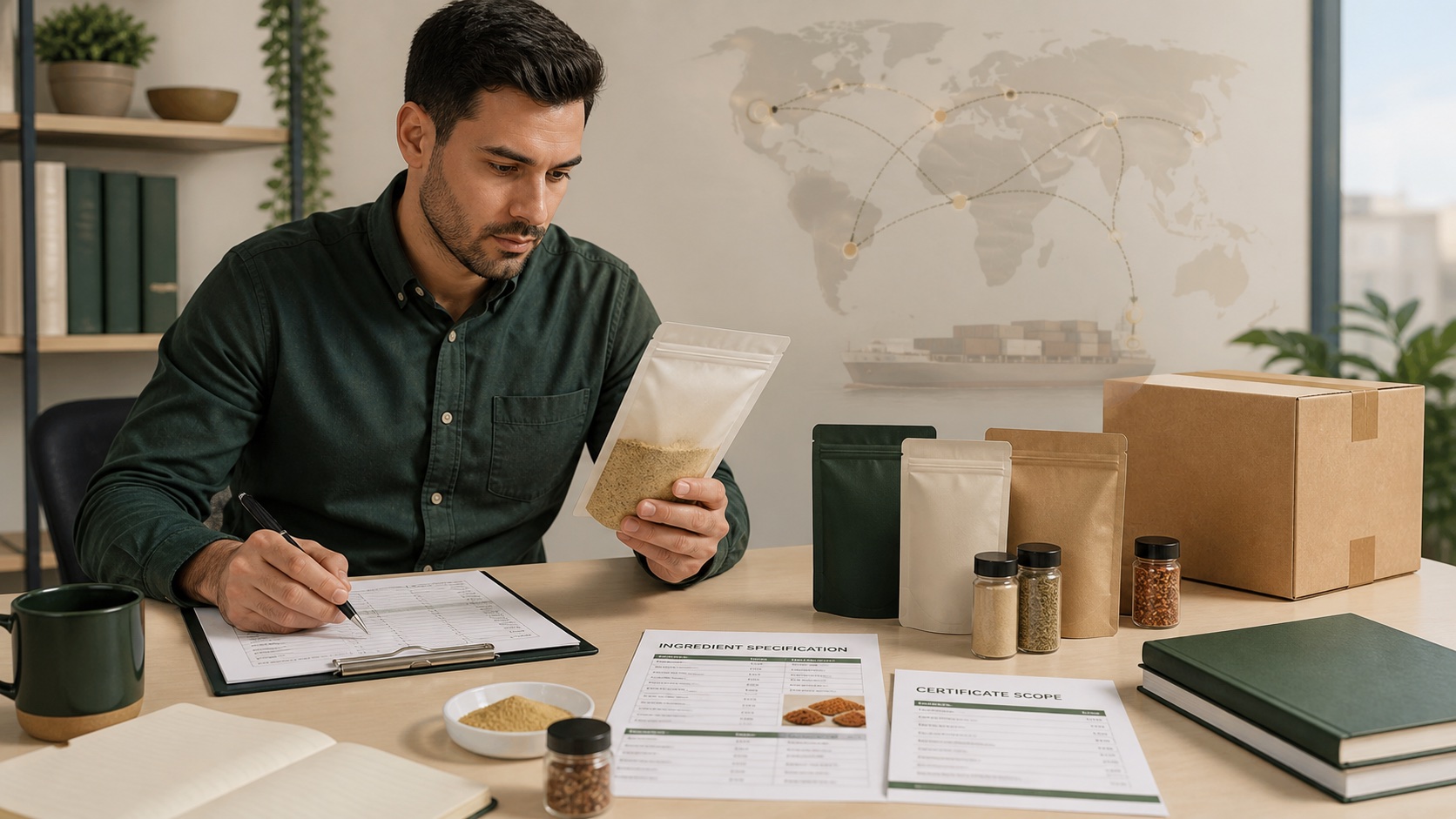
J-Origin Food helps importers, distributors, retailers, foodservice suppliers and private-label teams screen Asian supply options for Halal food markets. Compound seasonings and hot pot bases are the first category in this workflow; frozen dim sum, ready-to-cook foods and related products can be screened as separate SKU files. This guide explains how buyers in the United States, Saudi Arabia and the UAE can qualify the exact product, formula, facility, certificate scope, pack and destination-market route before samples or quotations. Halal status is not assumed from a category name, a factory profile or another product’s certificate.
What an Asian Halal supply-chain solution should cover
A useful sourcing partner does more than send a list of certified products. The project should connect product selection, suitable factory matching, certificate review, full specifications, samples, packaging, OEM or private label, label inputs, ambient or frozen handling and the supplier documents needed by the importer. Each category remains a separate technical file even when several products are combined into one commercial programme.
For J-Origin, compound seasonings are the first commercial priority. Frozen dim sum, dumplings and other Asian foods are adjacent sourcing categories, but inclusion in a Halal programme requires matching product, facility and certificate evidence. Oils, seasoned nuts, noodles and ready-to-cook items can also be screened when they fit the buyer’s channel and evidence requirements.
What counts as a compound-seasoning project?
For sourcing purposes, the category can include hot pot and malatang bases, soup concentrates, cooking pastes, blended seasoning powders, bouillon-style products, dipping sauces and related kitchen formulations. A product name alone is not enough. Buyers should state how the seasoning will be used, whether it is sold at retail or used in foodservice, and whether the first project is a standard formula, packaging change, flavour adjustment or new formulation.
Browse the current sauces, soup bases and seasonings category for product formats. Public specifications do not establish Halal status, stock, MOQ or private-label eligibility; those points must be confirmed for the selected SKU and factory.
Why Halal evidence must be checked at SKU level
Compound seasonings often contain sub-ingredients that are not obvious from the front-of-pack name. Buyers may need source information for flavours, emulsifiers, processing aids, yeast products, hydrolysed proteins, animal-derived inputs and alcohol-related ingredients or processing steps. A certificate must match the producing facility and cover the relevant product or category during its validity period.
Ask for the certificate itself, its product schedule or scope attachment, the issuing body, certificate number, facility name and address, issue and expiry dates, and any conditions or exclusions. If the destination market or customer accepts only selected certification bodies, confirm that point before approving artwork or ordering packaging.
United States buyer checklist
In the United States, the importer remains responsible for the applicable Foreign Supplier Verification Program. FDA explains that covered importers must use risk-based supplier verification and ensure imported food is not adulterated or misbranded with respect to allergen labelling. Halal review does not replace the importer’s food-safety, ingredient, allergen and labelling work.
- Name the US FSVP importer and confirm the exact food and foreign supplier being evaluated.
- Request the complete formula and sub-ingredient information needed for hazard, allergen and label review.
- Separate the private Halal certification or customer standard from FDA requirements.
- State the sales channel: foodservice, Asian grocery, mainstream retail, ecommerce or private label.
- Confirm net contents, Nutrition Facts inputs, allergen presentation, importer/distributor details and any claims before artwork approval.
US distributors can use the Asian food wholesale USA sourcing page to prepare a broader commercial brief and the US FSVP buyer checklist for importer-role questions.
Saudi Arabia and UAE buyer checklist
Saudi and UAE projects should identify the exact destination and importer route rather than treating the Gulf as one set of requirements. Saudi buyers should confirm the current SFDA registration and import-document route and check the Saudi Halal Center’s recognised certification bodies where applicable. UAE buyers should confirm the accepted certification route and any intended use of the UAE Halal National Mark with the relevant authority or importer.
The presence of animal-derived inputs can materially change the document review. For example, a soup base containing meat or poultry ingredients should not be evaluated in the same way as a plant-based seasoning powder. A product bearing the word or mark “Halal” also needs evidence supporting that claim.
- Destination country, importer, intended registration route and label language.
- Halal certification body required or accepted for the project.
- Full formula, animal-origin inputs, processing aids and alcohol-related declarations.
- Factory, production line and product scope shown on the certificate.
- Retail or foodservice pack, case format, storage and planned shipment route.
Use the GCC Halal sourcing page for regional procurement inputs and the certification and compliance approach to structure document questions.
Choose the right supply route
Standard formula and current-supply check
This route can shorten evaluation only when the product, packaging, batch status and remaining shelf life are documented. Buyers should request a dated availability check. Immediate availability should not be claimed without batch-level stock evidence.
Packaging or artwork change
Changing a label or pack can create a separate packaging minimum even when the food formula remains unchanged. Confirm print quantities, label ownership, barcode responsibility, review sequence and obsolete-material risk.
Flavour adjustment or new formulation
A spice-level change, removal of an ingredient or replacement of an animal-derived input may affect sensory approval, technical specifications and Halal evidence. Record the approved sample and final formula before discussing a repeat-order programme.
RFQ fields that produce a comparable quotation
- Destination country, port and importer.
- Buyer channel and intended kitchen or retail application.
- Product type, flavour direction, format and dilution or serving method.
- Pack size, case format, estimated volume and target timing.
- Standard product, artwork change, flavour adjustment or new formulation.
- Required Halal certification body or customer approval standard.
- Animal-origin, alcohol-related, allergen and ingredient restrictions.
- Documents required before sample, commercial approval and shipment.
Send a structured brief through the contact form. Treat availability, MOQ, private-label scope and commercial terms as unconfirmed until they are returned in a dated response for the selected SKU, factory, pack and market. Do not rely on a catalogue-wide certification or inventory statement.
Related products without losing category focus
Plant oils such as sesame oil can extend a seasoning programme when their ingredient, allergen, packaging and certification evidence fits the market. Animal fats require a deeper source and Halal review. Seasoned nuts can serve retail and foodservice snack channels, but their nut allergens, seasoning inputs, oils, cross-contact controls and shelf-life evidence need a separate SKU file. Beverage, confectionery and bakery RFQs are outside this programme’s current focus.
Official starting points
- US FDA: FSVP final rule at a glance
- Saudi Food and Drug Authority: Halal certification issuing requirements
- Saudi Halal Center: recognised certification bodies
- UAE Ministry of Industry and Advanced Technology: registered Halal certification bodies
This article is a procurement checklist, not legal advice or a product certification statement. Requirements and accepted evidence must be checked for the exact product, facility, importer and destination before a claim, label or order is approved.
Choose the next step
Continue with the right sourcing request
MOQ, timing, sampling, documents and supply options are confirmed for the selected SKU, producing facility, project and destination market.