
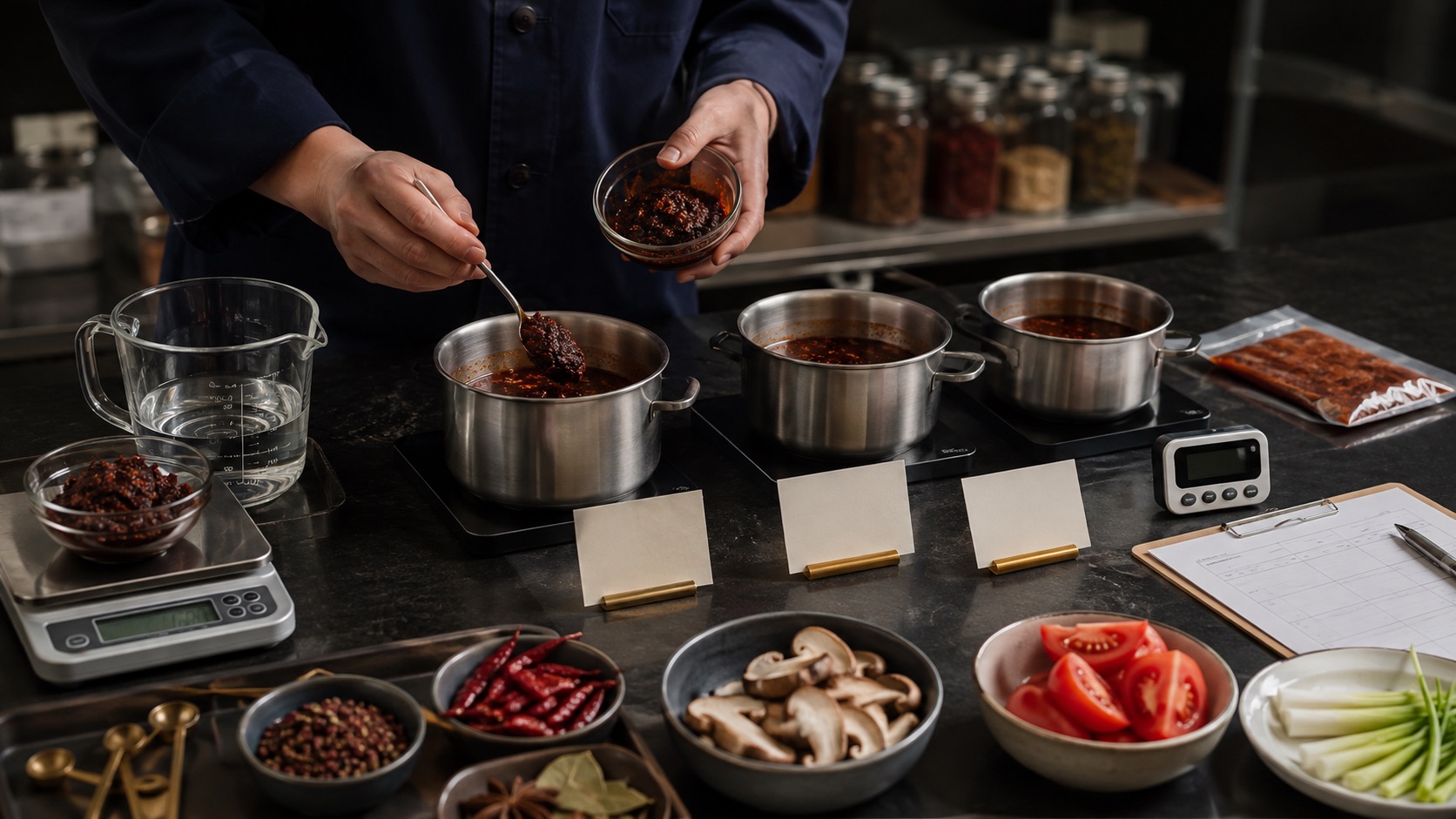
A hot pot base can perform well in one tasting and still fail a distributor or restaurant programme. The usual problem is not the first flavour impression. It is an uncontrolled preparation method, incomplete ingredient review, packaging mismatch or an undocumented change between the approved sample and the commercial product. This checklist gives importers, foodservice distributors and private-label buyers a repeatable way to compare compound seasonings before selecting a wholesale SKU.
Do not compare hot pot bases by pouch weight alone
Two products with the same net weight may produce different amounts of finished broth and behave differently during service. Oil-to-solid ratio, salt level, chilli and pepper profile, fermented ingredients, water addition, heating time and top-up practice all affect the result. A lower-cost pouch is not necessarily a lower-cost serving, and a concentrated base is not automatically more suitable for every kitchen.
Start with the required application: table hot pot, malatang line, back-of-house broth, retail cooking kit or an ingredient in another prepared food. Then compare products using the same pot, water, heat source, ingredients and service time. Browse the sauces, soup bases and seasonings range to identify candidate formats, but treat every public page as a starting point rather than a final commercial specification.
Build one controlled kitchen test for every candidate
Record the method before tasting. Without a written method, feedback such as “too weak” or “too oily” cannot be traced to the formula, the dilution or the person preparing the pot.
| Test field | What to record | Why it matters |
|---|---|---|
| Base and water | Exact mass of base, starting water and any later top-up | Allows a comparable yield and salt-strength review |
| Equipment | Pot size, heat source and service format | Changes evaporation, scorching risk and solids movement |
| Heating sequence | Addition order, time to simmer and total service time | Shows whether the product is easy to reproduce in a real kitchen |
| Food load | Representative vegetables, meat, seafood, tofu or noodles | Ingredients absorb salt and fat and can change the broth balance |
| Observations | Oil separation, sediment, aroma, heat curve, colour and aftertaste | Creates useful feedback for comparison or reformulation |
Do not turn a supplier’s suggested dilution into a universal claim. Use it only as a documented starting point for that specific sample, then approve the preparation method that matches the buyer’s channel.
Score performance, not just first-spoon flavour
A practical scorecard should cover the first taste and the later service period. Buyers can assess:
- Aroma release: whether the expected spice and savoury notes appear during heating rather than only in the unopened pouch.
- Heat curve: initial chilli impact, lingering heat and numbing sensation where relevant.
- Salt and savoury balance: before and after food is cooked in the broth.
- Oil and solids behaviour: separation, sediment, sticking and the need for stirring.
- Colour stability: whether the broth remains suitable for the intended service time.
- Ingredient compatibility: how the base works with the buyer’s typical vegetables, proteins, tofu products and noodles.
- Kitchen repeatability: whether different staff members can reproduce the approved result using the written method.
Use blind or coded samples when possible. The aim is not to produce a marketing score; it is to identify the formula and preparation method that the purchasing team can specify and the kitchen can repeat.
Review the complete formula before discussing Halal positioning
A product name such as clear oil, tomato or mushroom does not establish Halal status, vegetarian status or the absence of animal-derived inputs. Compound seasonings can include flavours, extracts, fermented ingredients, hydrolysed proteins, emulsifiers, processing aids or alcohol-related components that are not obvious from the front name.
The current public information for the Clear-Oil Hot Pot Soup Base, for example, lists chicken extract and liquor among its ingredients. That product should not enter a Halal shortlist on the strength of the “clear-oil” description. Any alternative formula would need its own ingredient file, producing-facility details and certificate scope review.
For a Halal programme, request the certificate, product schedule or scope attachment, issuing body, certificate number, facility name and address, issue and expiry dates, and any exclusions. Confirm whether the destination market or customer requires a particular recognised certification route before approving artwork. The Halal Asian food sourcing page explains how J-Origin separates product screening from unsupported catalogue-wide claims.
Separate product approval from label and import approval
A successful kitchen test does not complete the importer’s review. The buyer still needs the selected product’s formula, sub-ingredients, allergen information, nutrition inputs, shelf-life evidence, storage conditions, packaging materials, date-code format and manufacturer details required for the destination market.
For the United States, covered FSVP importers have risk-based foreign supplier verification responsibilities for each food and foreign supplier. Halal documentation is a separate commercial or religious-conformity file; it does not replace the importer’s food-safety, allergen and labelling work. For Saudi Arabia and the UAE, confirm the current importer route and accepted Halal certification body rather than treating the GCC as one uniform document list.
Choose the correct development route
Existing formula
This is the lowest-change route only when the exact formula, pack and factory are identified. Ask for a dated specification and current availability check. Do not infer stock, lead time or MOQ from a catalogue entry.
Packaging or artwork change
A private-label pack can leave the food formula unchanged while adding separate print quantities, artwork review, barcode ownership and obsolete-material risk. Freeze the approved label inputs and case format before packaging is ordered.
Flavour adjustment or new formulation
Changing chilli level, salt, oil, an animal-derived ingredient or an alcohol-related input can affect sensory performance, specifications and Halal evidence. Treat the revised sample as a new approval file. Keep the sample code and final formula revision together so the commercial batch is not compared with an obsolete tasting sample.
Use a sample-to-commercial change log
The buyer’s approval should identify the exact sample code, formula revision, factory, pack, kitchen method and approval date. Before a commercial order, compare that record with the quotation and final specification. Any change in formula, facility, pack material, label, certificate scope or shelf-life statement should be visible to the buyer before production.
For category comparison, buyers may also review the Tomato Soup Base and Mushroom Soup Base · Clear Style. These links provide different flavour directions; they do not establish that the products share the same ingredients, preparation method, certification or private-label terms.
RFQ fields for a useful hot pot base shortlist
- Destination country, importer, channel and port.
- Kitchen application: table hot pot, malatang, back-of-house broth or retail.
- Target flavour direction, chilli and numbing profile, oil preference and ingredient restrictions.
- Representative food load and required service time.
- Retail or foodservice pack, case format and expected volume range.
- Existing formula, packaging change, flavour adjustment or new formulation.
- Halal certification body or customer standard to be checked, if applicable.
- Required formula, allergen, nutrition, shelf-life, quality and shipment documents.
Send these fields through the J-Origin Food sourcing brief. A useful response should distinguish what is documented, what still needs factory confirmation and what requires a new sample. Price, MOQ, stock, lead time and certification remain unconfirmed until they are tied to the selected SKU, factory, pack and destination.
Official reference points
- US FDA: FSVP Final Rule at a Glance
- Saudi Food and Drug Authority: recognised Halal certification bodies
- UAE Ministry of Industry and Advanced Technology: registered Halal certification bodies
This is a procurement and sample-review checklist, not legal advice or a certification statement. Confirm requirements, specifications and evidence for the exact product, producing facility, importer and destination market before approving a claim, label or order.
Choose the next step
Continue with the right sourcing request
MOQ, timing, sampling, documents and supply options are confirmed for the selected SKU, producing facility, project and destination market.